Enterprise AI vs Small Business: How AI Adoption Scales Across Company Sizes
Artificial intelligence is transforming how businesses operate. But the way a solopreneur uses AI looks nothing like how a multinational corporation deploys it. The goals, budgets, security requirements, governance needs, and implementation timelines are completely different.
The difference between enterprise AI vs small business adoption is not just about budget — it is a spectrum that runs from a freelancer using ChatGPT for email drafts to a Fortune 500 company fine-tuning its own large language models on proprietary data. Where your business sits on that spectrum determines everything about your AI strategy.
In this guide, we compare AI adoption across three distinct tiers: small businesses (1-50 employees), medium businesses (50-500 employees), and enterprises (500+ employees). You will learn how goals, budgets, governance, security, integrations, and implementation strategies scale. More importantly, you will discover practical steps your business can take right now, regardless of size.
According to the U.S. Small Business Administration, AI adoption among small businesses jumped from 14% in 2023 to 55% in 2025. The U.S. Chamber of Commerce reports that 96% of small and medium businesses plan to adopt AI in some form. The interest is there. The question is how to approach it the right way for your specific situation.

The AI Adoption Spectrum by Company Size
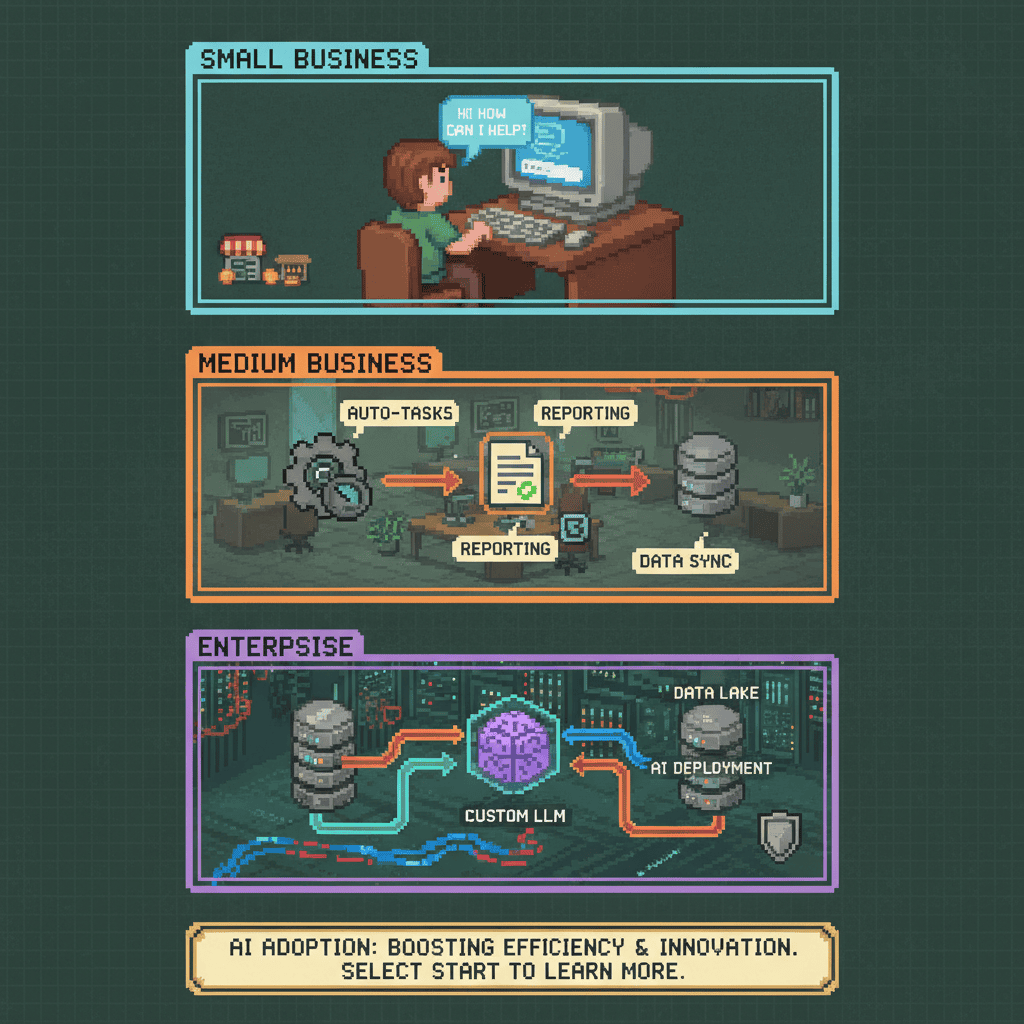
AI adoption scales inversely with company size in speed but directly in complexity. Small businesses adopt AI fastest due to simpler decision-making. Enterprises take longer but deploy more complex, custom solutions. Medium businesses sit in the middle, balancing speed with structure.
This spectrum framework helps you understand where your business sits today and where it is heading. A small business using one or two AI tools today will face very different challenges when it grows to 100 employees. Knowing the roadmap prevents costly mistakes.
Small Business AI: Speed and Simplicity
Small businesses adopt AI primarily for cost savings and efficiency. Without dedicated IT teams or large budgets, they need tools that are affordable, easy to set up, and immediately useful.
Common AI tools for small businesses include: ChatGPT for content and customer responses, Grammarly for writing assistance, Canva AI for design, HubSpot AI for CRM, and basic chatbots for customer service. These are off-the-shelf SaaS products with monthly subscriptions typically under $100 per tool.
Decision speed is a major advantage. A small business owner can evaluate, purchase, and deploy a new AI tool in days. Small businesses see the biggest impact from AI time-saving tools because even saving a few hours per week represents a meaningful percentage of total capacity. According to McKinsey, small businesses that adopt AI see 10-20% productivity gains in specific tasks.
Risk tolerance is high because experimenting with a $20/month tool carries minimal downside. For founders who want to move fast, startups leverage AI to punch above their weight by taking an experiment-first approach that avoids costly commitments.
Medium Business AI: Scaling with Purpose
Medium businesses face a unique challenge. They have outgrown simple point solutions but cannot afford enterprise-grade custom development. Their AI strategy must balance the agility of a small business with the structure needed to coordinate across departments.
Common AI tools for medium businesses include: Zapier AI for workflow automation, Notion AI for knowledge management, Salesforce Einstein for sales intelligence, HubSpot AI for marketing automation, and custom workflow automations using APIs. These tools cost $500-5,000 per month and often require some technical setup.
Decision-making at this tier involves more people. Department heads need to sign off, budgets require justification, and vendor evaluations take time. The timeline from decision to deployment stretches from weeks to months. AI workflows that scale with your business as you grow become essential at this stage.
The key differentiator for medium businesses is that they need tools capable of handling greater complexity without requiring a dedicated AI engineering team. They benefit most from platforms that offer both power and ease of use, bridging the gap between simple and sophisticated.
Enterprise AI: Custom Solutions at Scale
Enterprises approach AI as a strategic investment. Their goals go beyond cost savings to include competitive advantage, market differentiation, and transformation of entire business processes. They build rather than buy.
Common enterprise AI tools include: Custom LLM deployments on Azure AI, AWS Bedrock, or Google Vertex AI. Fine-tuned models trained on proprietary data. Custom chatbots, recommendation engines, predictive analytics systems, and automated decision-making platforms. Budgets start at $50,000 per year and can reach millions for full-scale deployments.
The Stanford HAI Enterprise AI Playbook documents 51 case studies across industries, showing how enterprises deploy AI for strategic outcomes. McKinsey reports that enterprise AI deployments typically take 6-18 months from decision to production. Every tool must pass security review, legal compliance, and vendor due diligence before deployment.
Understanding the difference between AI agents and chatbots becomes critical at the enterprise level. Enterprises need autonomous systems that integrate deeply with existing infrastructure, not standalone tools that operate in isolation.
AI Budgets: How Spending Scales by Company Size
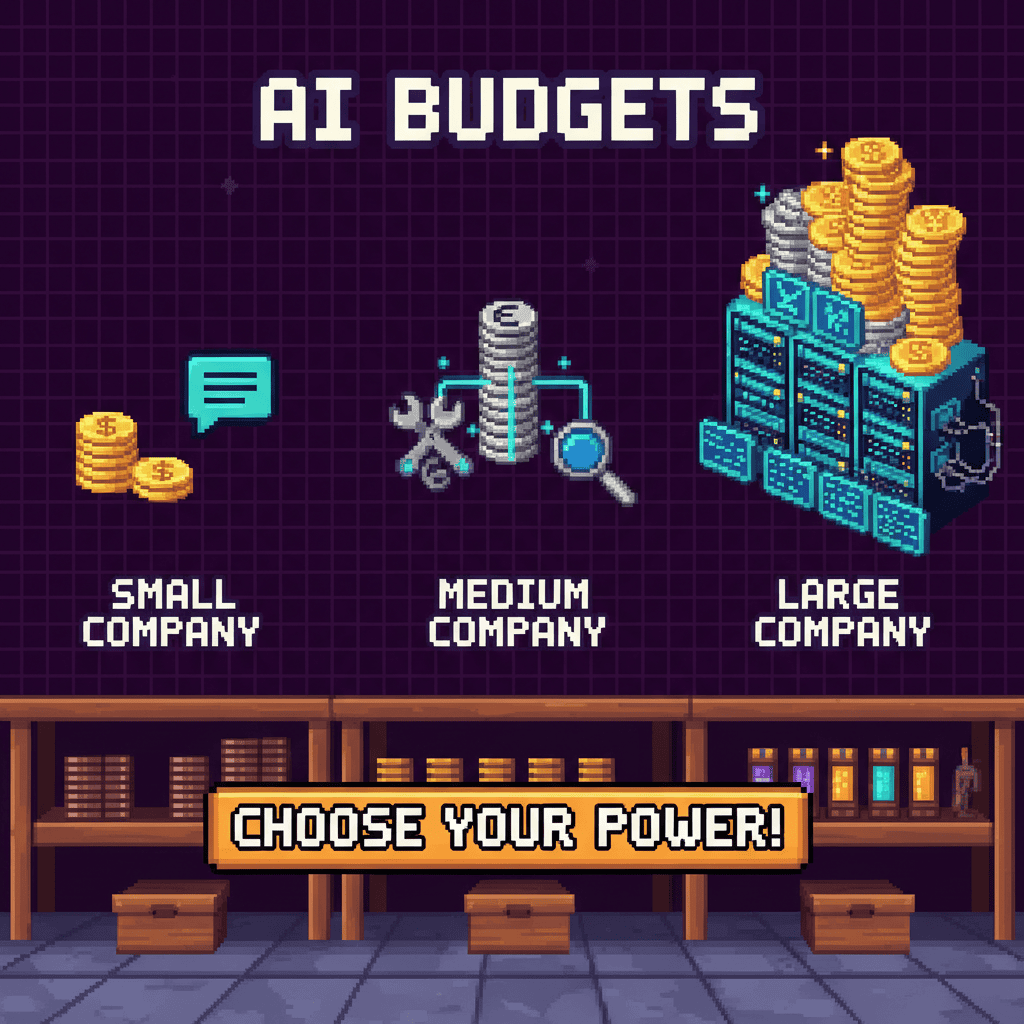
Budget is the most visible differentiator in AI adoption. The gap between what a small business and an enterprise spend on AI is not a matter of scale. It is a difference in kind. Small businesses buy subscriptions. Enterprises build infrastructure.
| Budget Category | Small Business | Medium Business | Enterprise |
|---|---|---|---|
| Monthly spend | $20-500 | $500-10,000 | $10,000+ |
| Tool type | SaaS subscriptions | SaaS + integrations | Custom solutions |
| Decision speed | Days | Weeks to months | Months to years |
| ROI timeline | Immediate (cost savings) | 3-6 months (efficiency) | 12-18 months (strategy) |
| Approval process | Owner or CEO | Dept head + committee | Executive + board |
The ROI expectations differ dramatically at each tier. A small business measures success in hours saved this week. An enterprise measures success in market share gained over the next two years.
Neither approach is wrong. They are simply different games with different scorecards.
Governance: From Simple Rules to Compliance Programs
AI governance for enterprise sounds like a topic only large corporations need to worry about. But governance simply means having guidelines for how your team uses AI responsibly. The scale of those guidelines changes with company size.
A small business might need nothing more than a verbal reminder: “Do not paste customer data into ChatGPT.” A medium business should have a written AI policy covering data handling, approved tools, and employee training. An enterprise needs a full governance framework with an ethics board, algorithmic auditing, and third-party assessments.
| Governance Element | Small Business | Medium Business | Enterprise |
|---|---|---|---|
| AI policy | Informal guidelines | Written policy document | Governance framework |
| Data protection | Basic awareness | Data handling procedures | Full compliance program |
| Employee training | Optional | Required training | Ongoing certification |
| Oversight | Owner self-monitors | Designated manager | Governance committee |
| Auditing | None | Annual review | Continuous + third-party |
The important insight is that governance scales naturally. Small businesses do not need enterprise-level compliance programs.
But they should start with good habits: using reputable tools, avoiding sensitive data in public AI systems, and reviewing privacy policies before adopting new software. These habits create a foundation that grows with the business.
Security and Compliance: Different Stakes at Every Level
AI security compliance requirements grow exponentially, not linearly, with company size. The stakes are different because the data volume, regulatory exposure, and potential damage from breaches all scale faster than headcount.
For small businesses, security means basic data protection: using reputable AI tools, enabling two-factor authentication, and avoiding sharing customer information in public AI platforms. These steps cost nothing and take minutes to implement.
Medium businesses need to consider SOC 2 readiness, GDPR compliance (if serving European customers), vendor security assessments, and data encryption. These require dedicated attention and often outside expertise but are manageable without a full security team.
Enterprises face the full spectrum: HIPAA for healthcare, SOC 2 for SaaS providers, PCI DSS for payment processing, GDPR for any European operations. They need dedicated security teams, penetration testing, data residency controls, and model security to prevent prompt injection and data leakage attacks. Debunking the myth that AI security is only an enterprise concern is important, because small and medium businesses still have real risks to manage. The scale of response differs, not the existence of the risk.
Integrations: Point Solutions vs. API Ecosystems
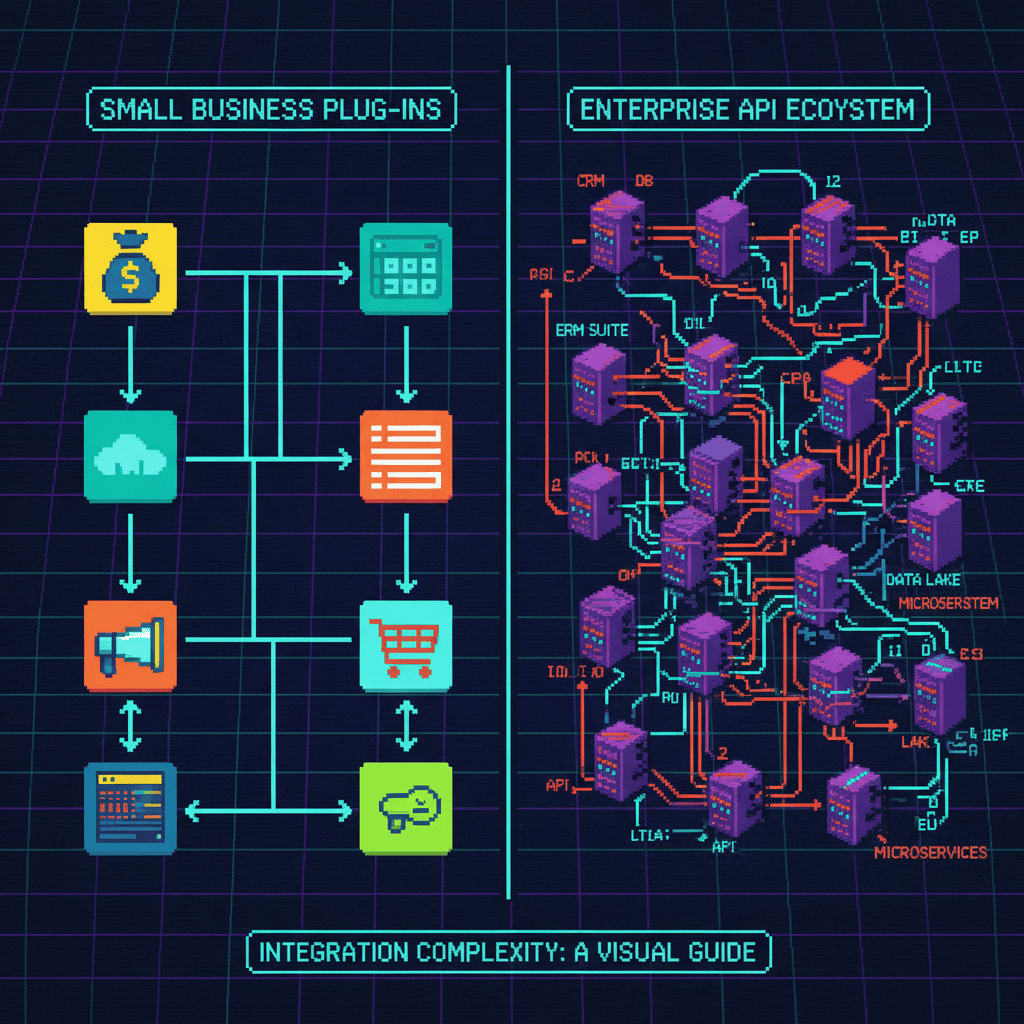
How AI tools connect to your existing systems is one of the most practical differences between company sizes. Think of it this way: a small business plugs in a lamp. An enterprise rewires the entire building.
Small businesses use standalone AI tools with minimal integration. A ChatGPT subscription, a Canva AI account, and a basic chatbot widget on the website. Each tool works independently and replaces a manual task. No complex setup required.
Medium businesses need their tools to talk to each other. CRM systems connect to email marketing platforms. Customer service chatbots pull data from order management systems. Workflow automation tools like Zapier bridge the gaps between disconnected software. The integration layer becomes as important as the tools themselves.
Enterprises build custom API ecosystems. Data pipelines feed AI models with real-time information from ERP, CRM, HR, and supply chain systems. Legacy systems require custom connectors. Multi-cloud strategies spread workloads across AWS, Azure, and Google Cloud for redundancy and cost optimization. The complexity is orders of magnitude higher, but so is the potential impact.
Regardless of company size, the integration approach should match your needs. AI-powered customer service at different scales follows the same pattern: simpler standalone tools for smaller businesses, integrated platforms for medium companies, and fully custom solutions for enterprises.
Implementation Timelines: Speed vs. Thoroughness
Your AI implementation strategy timeline varies enormously “we want AI” to “we are using AI” varies enormously by company size. Smaller companies move faster but often need to revisit their choices. Larger companies take longer but build more durable solutions.
Small businesses can go from decision to active use in 1-4 weeks. The owner evaluates a tool, tries it, and either adopts it or moves on. Medium businesses need 1-6 months for testing, training, departmental coordination, and data migration. Enterprises require 6-18 months for security reviews, vendor selection, custom development, and compliance sign-offs.
The practical takeaway: do not compare your timeline to a company at a different tier. A small business deploying AI in a week is moving at exactly the right speed. An enterprise taking a year is also moving at the right speed. Both approaches match their context.
Can Small and Medium Businesses Close the AI Gap?
Yes. And here is why the conventional narrative that small businesses are “getting left behind” misses the full picture.
Small businesses have advantages that enterprises cannot match. They have no legacy systems to fight. They can make decisions in days instead of months. They can experiment with new tools at virtually no risk. A $20/month AI subscription is a rounding error for a small business owner, but the productivity gain can be transformative.
Medium businesses can leverage scale without enterprise complexity. They have enough employees to benefit from workflow automation and data-driven decision making, but they lack the bureaucracy that slows enterprise adoption. This sweet spot is where many of the most innovative AI deployments happen.
The real gap is not technology. It is strategy. Small and medium businesses need a clear plan for which problems to solve with AI, which tools to use, and how to measure success. That strategy can be learned and refined over time. The businesses that succeed will be the ones that start now, iterate quickly, and scale their AI capabilities as they grow.
FAQ: Company Size and AI Adoption
How do small businesses use AI?
Small businesses use AI primarily for cost savings and efficiency. Common applications include AI-powered writing tools (ChatGPT, Grammarly), customer service chatbots, social media scheduling, basic data analysis, and automated email marketing. All of these are available through affordable SaaS subscriptions typically under $100 per month.
What is the difference between enterprise and small business AI?
Enterprise AI involves custom-built solutions, dedicated infrastructure, and comprehensive governance frameworks. Small business AI relies on off-the-shelf tools and SaaS products. The enterprise AI vs small business difference comes down to complexity: enterprises build, small businesses buy.
How much do companies spend on AI by size?
Small businesses spend $20-500 per month on AI tools. Medium businesses invest $500-10,000 per month including integration costs. Enterprises spend $10,000+ per month, often reaching millions for custom development, infrastructure, and compliance programs.
Do small businesses need AI governance?
Yes, but at an appropriate scale. Small businesses need basic guidelines: avoid sharing sensitive customer data in AI tools, review privacy policies before adopting new tools, and educate employees on responsible AI use. Full compliance programs are unnecessary for small operations.
What AI tools are best for medium-sized businesses?
Medium businesses benefit from tools that balance power with ease of use. Top choices include Notion AI for knowledge management, Zapier Central for workflow automation, HubSpot AI for CRM, and Salesforce Einstein for sales intelligence. The key is choosing tools that integrate with existing systems.
Can small businesses compete with enterprise AI?
Absolutely. Small businesses can adopt AI faster than any enterprise. Without legacy systems or bureaucratic approval processes, a small business can deploy AI tools in days rather than months. The advantage is agility, not budget size.
Next Steps for Your Business
AI adoption is a spectrum, not a competition. Wherever your business sits on that spectrum, the right strategy starts with understanding your specific needs. The businesses that win with AI will be the ones that match their approach to their size, start where they are, and evolve as they grow.
Not sure where your business fits on the AI adoption spectrum? When you are ready to build an AI strategy that fits your business size and budget, contact Pixel Studio Creations. We help small and medium businesses navigate the AI landscape without the enterprise price tag.