
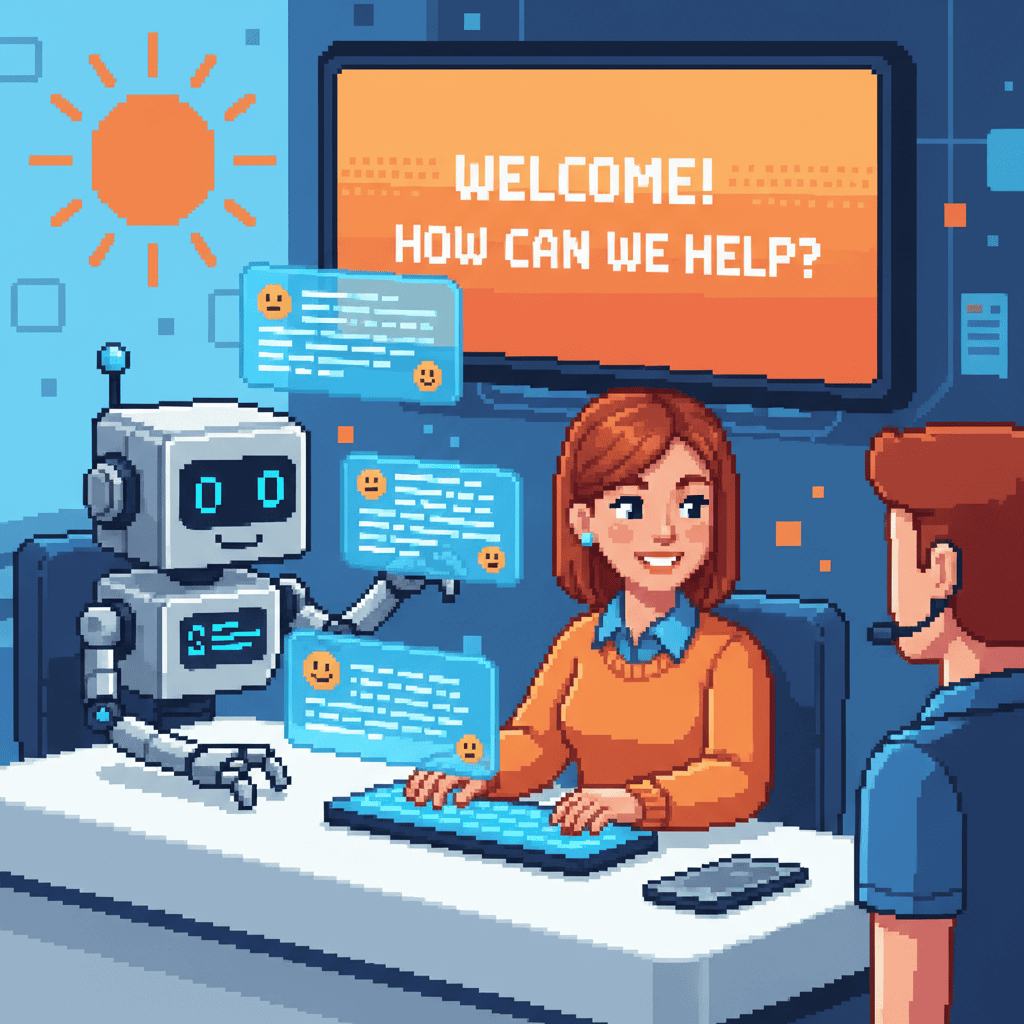
AI in Customer Service: Faster Responses Without Losing the Human Touch
A customer contacts a small business with a billing issue. They get an instant AI chatbot response. It is fast, accurate, and completely impersonal. The customer feels frustrated because their problem requires nuance, not a scripted reply. This is the reality of AI customer service in 2026: speed is no longer the challenge. The real question is delivering that speed without losing the human connection that keeps customers loyal.
AI has transformed how businesses handle customer interactions. But speed without empathy creates a different kind of bad experience. Here is where AI excels, where it falls short, and a practical decision framework to help small businesses find the right balance.
AI does not solve every customer service challenge on its own. But when deployed thoughtfully, it makes your team more effective rather than replacing it.
What Is AI Customer Service? (And What It Isn’t)
AI customer service encompasses chatbots, automated email responses, AI-powered ticket routing, sentiment analysis, and self-service knowledge bases. These tools handle repetitive, high-volume, low-complexity customer interactions. According to Gartner, 80% of customer service organizations will apply generative AI in some form by 2026.
What AI customer service IS: a smart assistant that handles routine work so your human agents can focus on conversations that matter. What it IS NOT: a complete replacement for human agents, a set-it-and-forget-it solution, or a magic fix for poor processes. The most common misconception is that AI means a robot answers every call. In reality, the best implementations route simple queries to AI and complex ones to humans.
The Speed Advantage: How AI Cuts Response Times
An AI chatbot responds to common questions in under 5 seconds. Compare that to 12 or more hours for email or 5 to 10 minutes for live chat. Zendesk reports that AI-powered customer service reduces first response time by 80%. For a small business handling 50 inquiries a day, that is not just efficiency. It is the difference between a customer who feels heard and one who has already moved to a competitor.
AI also provides something small businesses have never been able to afford: 24/7 availability. It never sleeps, never takes breaks, and serves customers across every time zone. For a startup or local business, this means always-on support without hiring overnight staff.
The critical caveat: fast response is not the same as good response. Speed matters, but accuracy and empathy matter more for customer satisfaction. A fast wrong answer is worse than a slightly slower correct one.
Where AI Falls Short: The Limits of Automated Support
Emotional intelligence gap. AI cannot genuinely empathize. When a customer is upset about a failed birthday gift delivery, “We apologize for the inconvenience” feels hollow. Customers can tell the difference between a scripted response and a person who actually cares.
Complex problem-solving. Multi-layered issues like billing disputes involving multiple orders require human judgment. AI handles one issue at a time; humans see the bigger picture.
Escalation failures. When AI cannot resolve an issue but keeps the customer in a loop instead of escalating, frustration compounds. Forrester research shows that 60% of consumers feel frustrated when they cannot reach a human agent.
Language nuance. Sarcasm and emotional subtext are lost on AI. A customer saying “Great, another billing error” is not expressing satisfaction. They are expressing frustration, and your system needs to recognize that.
The Human Touch: What Customers Actually Want
PwC research shows that 82% of consumers want more human interaction in the future, not less. Customers are willing to pay up to 16% more for brands that provide excellent human customer service. That is a direct revenue impact that automation alone cannot deliver.
According to the Salesforce State of the Connected Customer report, 73% of customers say friendly, knowledgeable human service is the most important factor in a positive experience. AI can be fast, but humans build the trust that keeps customers coming back.
What does “human touch” actually mean? Active listening, emotional acknowledgment, creative problem-solving, personalized recommendations, and accountability when something goes wrong. There is also a generational split: younger customers prefer AI for simple interactions, but even they want humans for complex or emotional issues. The pattern is consistent across every age group: AI for speed, humans for depth.
Here is the small business advantage: your human touch IS your competitive edge. A local business that remembers a customer’s name, understands their history, and genuinely cares about their experience cannot be replicated by any chatbot.
When to Use AI vs. Humans: A Decision Framework
Most businesses struggle not because the technology fails, but because they lack a clear framework for deciding where AI helps and where humans are essential.
The Four-Category Decision Matrix
Automate with AI: FAQ answers, order status checks, password resets, appointment scheduling, shipping updates. If the question has a clear answer and the customer does not need emotional acknowledgment, AI handles it faster and more consistently.
AI-first, human-ready: Account inquiries, simple complaints, product recommendations, initial triage. AI tries once, and if the customer is not satisfied, a human steps in immediately.
Human-led, AI-assisted: Complex billing disputes, emotional complaints, loyalty conversations, service recovery. AI provides the agent with customer history and suggested responses before the human joins.
Always human: Crisis situations, VIP relationships, nuanced advice, legal or compliance issues, deeply personal matters. These conversations define your brand. Never automate them.
The Five-Question Decision Checklist
- Is the question repeatable and rule-based? If yes, automate it.
- Does the customer need emotional acknowledgment? If yes, route to a human.
- Is the resolution within a single interaction? If yes, AI can handle it.
- Does it involve money, contracts, or legal matters? If yes, a human must be involved.
- Is the customer showing signs of frustration? If yes, escalate to a human immediately.
In our experience, the businesses that succeed with AI customer service are the ones that design these rules first, then deploy the technology.

The Hybrid Model: Combining AI and Human Support
The hybrid model is not “AI handles everything until it cannot.” It is a designed system with three layers. Layer 1 (AI handles): Instant triage, FAQ, order status, and scheduling, handling 60% to 70% of incoming volume. Layer 2 (AI assists humans): AI provides agents with customer history, suggested responses, and sentiment alerts before the conversation is transferred. Layer 3 (Human owns): Complex resolution, emotional conversations, and VIP service. Humans make the final call with AI context in the background.
In practice: a customer contacts support. The AI chatbot asks clarifying questions. If simple, it resolves instantly. If complex, the AI gathers information and routes the conversation to a human with full context. Industry benchmarks show the hybrid model achieves 90%+ customer satisfaction while reducing agent workload by 40% to 50%.
For small businesses: you do not need five layers of complexity. Start with a chatbot for FAQ and a simple ticketing system. Add layers as you grow. If you are a startup building your first support system, our guide on AI for startups covers the foundational steps.
Real-World Examples of AI + Human Customer Service
A local e-commerce store uses AI to handle order tracking and return initiation (60% of tickets). Human agents handle product questions and complaints. Result: 45% faster response times with the same team size. A professional services firm deploys a chatbot that qualifies inquiries and schedules consultations after hours. Result: 3x more qualified leads captured outside business hours.
A restaurant uses AI for reservation confirmations and menu questions, freeing staff to focus on in-person guest experience. A SaaS startup lets AI resolve 70% of technical support tickets (password resets, feature questions, how-tos). A support team of 2 handles volume that would normally require 5 people.
Each example reinforces the same principle: AI handles volume, humans handle value. The balance point shifts depending on your business type, but the pattern is universal.

Mistakes to Avoid When Implementing AI Customer Service
Deploying AI without a human escalation path. If customers cannot reach a human within 2 to 3 interactions, you have created a frustration machine. Always provide a clear path to a human agent.
Training AI on incomplete or outdated information. AI is only as good as its knowledge base. Outdated product information leads to confident wrong answers. Audit your knowledge base monthly.
Ignoring customer sentiment. If your chatbot does not detect frustration and escalate, customers will leave. Set up sentiment-triggered escalation rules from day one.
Automating before fixing broken processes. If your human support process is disorganized, automating it just creates automated chaos. Fix the process first, then add AI.
Choosing tools based on features, not fit. Enterprise platforms are overkill for a 5-person business. Start with a simple chatbot like Tidio, Crisp, or HubSpot free chat and grow from there.
Getting Started: AI Customer Service for Small Businesses
You do not need a massive budget or a dedicated tech team. Here is a practical plan:
Step 1: Audit your support volume. Track inquiries for 1 to 2 weeks. Categorize into FAQ-type (automatable), complex (human-required), and in-between. Step 2: Start with one AI tool. A live chat widget with chatbot handles FAQ and initial triage. Setup takes 2 to 4 hours. Step 3: Build escalation rules. Define when the chatbot hands off: after 2 failed attempts, when sentiment is negative, when billing or legal topics arise, or when the customer requests a human.
Step 4: Train your human agents. Show them how to use AI-provided context and pick up mid-conversation. Step 5: Measure and iterate. After 30 days, review AI resolution rate, satisfaction scores, and where customers get stuck. Adjust based on data. Step 6: Add layers as you grow. As volume increases, add ticket routing, sentiment analysis, and automated follow-ups.

Recommended Tools for Small Businesses
- Tidio (free tier + $29/mo) Best for e-commerce. Live chat combined with AI chatbot.
- Crisp (free tier + $25/mo) Best for startups. Shared inbox with bot builder.
- HubSpot Service Hub (free tier + $20/agent/mo) Best for CRM-integrated teams.
- Intercom (starts at $39/seat/mo) Best for SaaS with advanced AI features.
- Freshdesk (free tier + $15/agent/mo) Best for SMBs wanting a full helpdesk.
The Bottom Line: AI Amplifies Your Team, It Does Not Replace It
AI in customer service delivers faster response times, 24/7 availability, and handles 60% to 70% of routine volume. But speed and efficiency are only part of the equation. The human touch remains irreplaceable for empathy, complex problem-solving, and building relationships that turn one-time buyers into loyal customers.
The winning strategy is not AI or humans. It is AI and humans working together. AI handles volume. Humans handle value. The real competitive advantage for small businesses is not cheaper AI tools. It is the combination of efficient AI for speed and genuine human care for depth. When you deploy AI with intention, it works alongside your team, not against it.
Ready to implement AI customer service the right way? Contact Pixel Studio Creations for a free support workflow audit. We will help you find the right balance, recommend tools that fit your budget, and build a hybrid model that keeps your customers happy.
Frequently Asked Questions About AI in Customer Service
Can AI replace human customer service?
AI can handle 60% to 70% of routine inquiries like FAQ answers, order status checks, and appointment scheduling. However, it cannot genuinely empathize, solve complex multi-layered issues, or build customer relationships. The most successful approach combines AI for volume and humans for value.
What are the benefits of AI in customer service?
AI provides instant response times (under 5 seconds versus hours for email), 24/7 availability, consistent answers for common questions, automatic ticket routing, and the ability to handle unlimited simultaneous conversations. For small businesses, AI enables always-on support without hiring overnight staff.
How does AI improve customer service response time?
AI chatbots respond in under 5 seconds to common questions, compared to 12 or more hours for email. AI also reduces first response time by automatically categorizing and routing tickets to the right agent, eliminating manual triage delays.
When should a chatbot escalate to a human agent?
A chatbot should escalate when: it fails to resolve the issue after 2 attempts, the customer expresses frustration, the issue involves billing or legal matters, or the customer explicitly requests a human. Clear escalation rules prevent frustration.
What are the limitations of AI in customer service?
AI lacks genuine empathy, struggles with complex problems, cannot understand sarcasm or emotional nuance, handles one issue at a time, and can confidently provide wrong answers if its knowledge base is outdated. These limitations make human agents essential for high-stakes interactions.
How do customers feel about AI in customer service?
Customer sentiment is mixed. While customers appreciate faster response times from AI, 82% still want more human interaction available, especially for complex or emotional issues. The key is offering both: AI for speed on simple matters, humans for depth on important ones.
How can small businesses use AI for customer service?
Start with a live chat widget that includes an AI chatbot (Tidio, Crisp, or HubSpot free chat). Use it to answer FAQs, route inquiries, and capture contact information after hours. Set up clear escalation rules so customers can always reach a human when needed.
What is the best AI tool for customer service?
For small businesses, Tidio is best for e-commerce, Crisp for startups, HubSpot Service Hub for CRM-integrated teams, and Freshdesk for full helpdesk functionality. All offer free tiers. The best tool depends on your business type, team size, and existing tech stack.