
Measuring AI ROI Beyond Cost Savings: A Small Business Guide to Full Productivity Metrics
You invested in an AI tool. The cost savings showed up in your spreadsheet, and your accountant was happy. But something feels incomplete. Your team works differently now. Projects move faster. Customers seem happier. There’s a shift happening that your balance sheet doesn’t capture. That’s because measuring AI ROI only by cost reduction misses the full picture of what AI actually delivers.
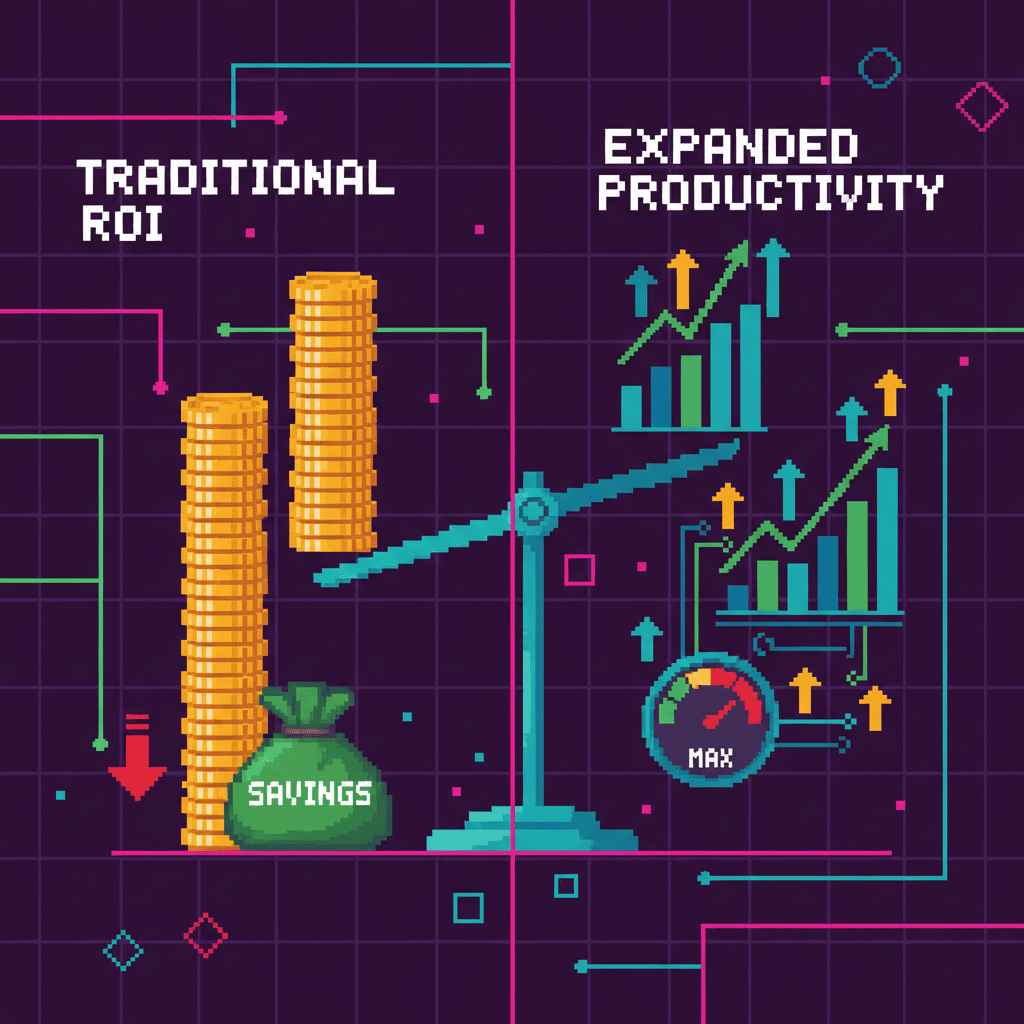
Traditional ROI focuses on the financial slice: headcount reduction, lower operational costs, decreased software spend. It’s the easiest thing to measure, so it becomes the only thing businesses track. But AI productivity ROI encompasses far more than dollars saved. It includes speed, satisfaction, wellbeing, and innovation capacity.
According to McKinsey’s 2025 global survey on AI, companies that measure comprehensive AI ROI see 2.5x higher returns than those tracking only cost metrics. The message is clear: what you measure determines the value you capture. Small businesses, in particular, need to expand their measurement frameworks because each improvement compounds differently when you have tighter margins and fewer employees.
In this guide, you’ll learn five expanded productivity metrics that go beyond cost savings, a practical framework for tracking them, and how to use that data to make smarter AI investment decisions. We’ll also link to the time savings that AI delivers for small businesses so you can see how these metrics connect to real-world outcomes.
Beyond Cost Reduction: The Full Productivity Picture
Measuring AI ROI only by cost savings is like judging a restaurant only by its food costs and ignoring customer reviews, staff morale, and menu innovation. The real value of AI shows up in multiple dimensions, not just the bottom line.
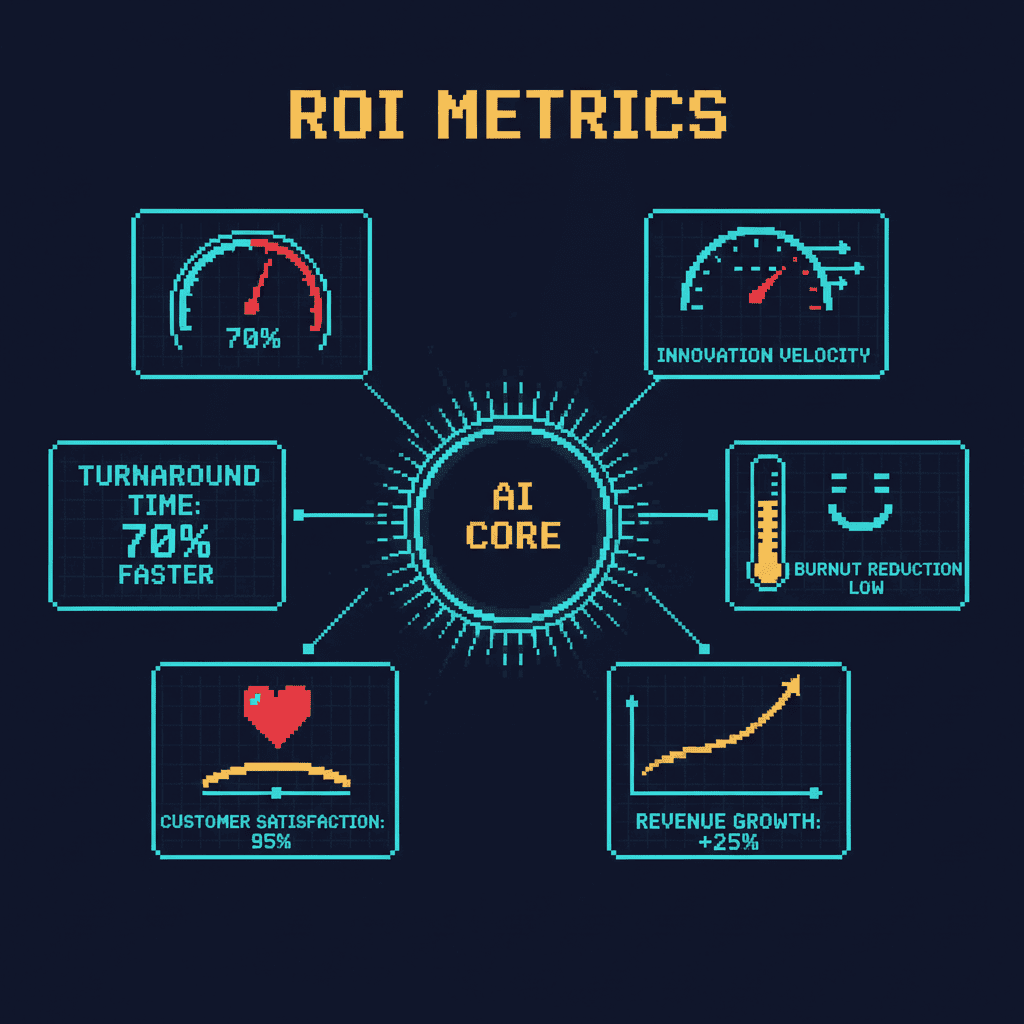
To shift the frame from “saved money” to “created value,” consider these five expanded ROI metrics that paint the full productivity picture:
- Turnaround time reduction: How much faster tasks and projects get completed
- Customer satisfaction improvement: How much happier your customers become
- Employee burnout reduction: How much healthier and more engaged your team stays
- Innovation velocity increase: How quickly new ideas move from concept to execution
- Revenue per employee growth: How much more each team member contributes
Each of these metrics matters because small businesses operate differently than enterprises. A 10-person team that reduces customer response time from 4 hours to 30 minutes creates a fundamentally different experience than a 500-person company doing the same thing. The impact per improvement is amplified when resources are limited.
These five metrics form the framework we’ll explore throughout this post. By the end, you’ll know exactly how to measure each one and what tools to use, even without a data science team or enterprise analytics platform.
Faster Turnaround Times as a Productivity Metric
AI turnaround time improvement is one of the most tangible and immediately measurable productivity gains. When AI compresses your project timelines, you deliver more output with the same team, which directly impacts revenue potential.
Here’s how turnaround time shifts across common small business scenarios:
- Customer support response time: Hours drop to minutes with AI chatbots handling initial queries
- Content creation cycles: Days compress to hours with AI writing and editing tools
- Data analysis and reporting: Weeks of manual analysis become minutes of automated insight generation
- Design revisions: Multiple rounds of back-and-forth become near-instant iteration
To measure turnaround time improvement, use this formula:
Turnaround Time Improvement (%) = ((Pre-AI Time – Post-AI Time) / Pre-AI Time) x 100
Zendesk’s customer experience benchmark report shows that businesses using AI customer service tools see average response time reductions of 70-80%. For a small business that previously took 4 hours to respond to inquiries, that’s a shift to under an hour. That kind of improvement changes how customers perceive your brand.
The key is establishing a baseline before you implement AI tools. Track your current turnaround times for 2-4 weeks, then measure again after deployment. Even small improvements matter when you have limited headcount. A team of five people that saves 2 hours per person per week gains 10 hours of productive capacity without hiring anyone.
For practical examples of where these time savings come from, explore AI workflows that accelerate turnaround times for marketing teams.
Customer Satisfaction as a Leading Indicator
AI customer satisfaction metrics serve as a leading indicator of sustainable business growth. While cost savings look backward at what you spent, customer satisfaction points forward to revenue you’ll earn.
AI boosts customer satisfaction through three primary mechanisms:
24/7 Availability
AI handles after-hours queries, eliminating the frustration customers feel when they reach a voicemail at 9 PM. Small businesses can now offer round-the-clock support without staffing night shifts.
Personalization at Scale
AI tailors responses, recommendations, and experiences to individual customers. A customer who gets a personalized follow-up feels valued in ways that generic autoresponders can’t achieve.
Consistency Across Interactions
AI delivers uniform quality across every interaction. Whether a customer contacts you on Monday morning or Saturday night, they receive the same level of responsiveness and accuracy.
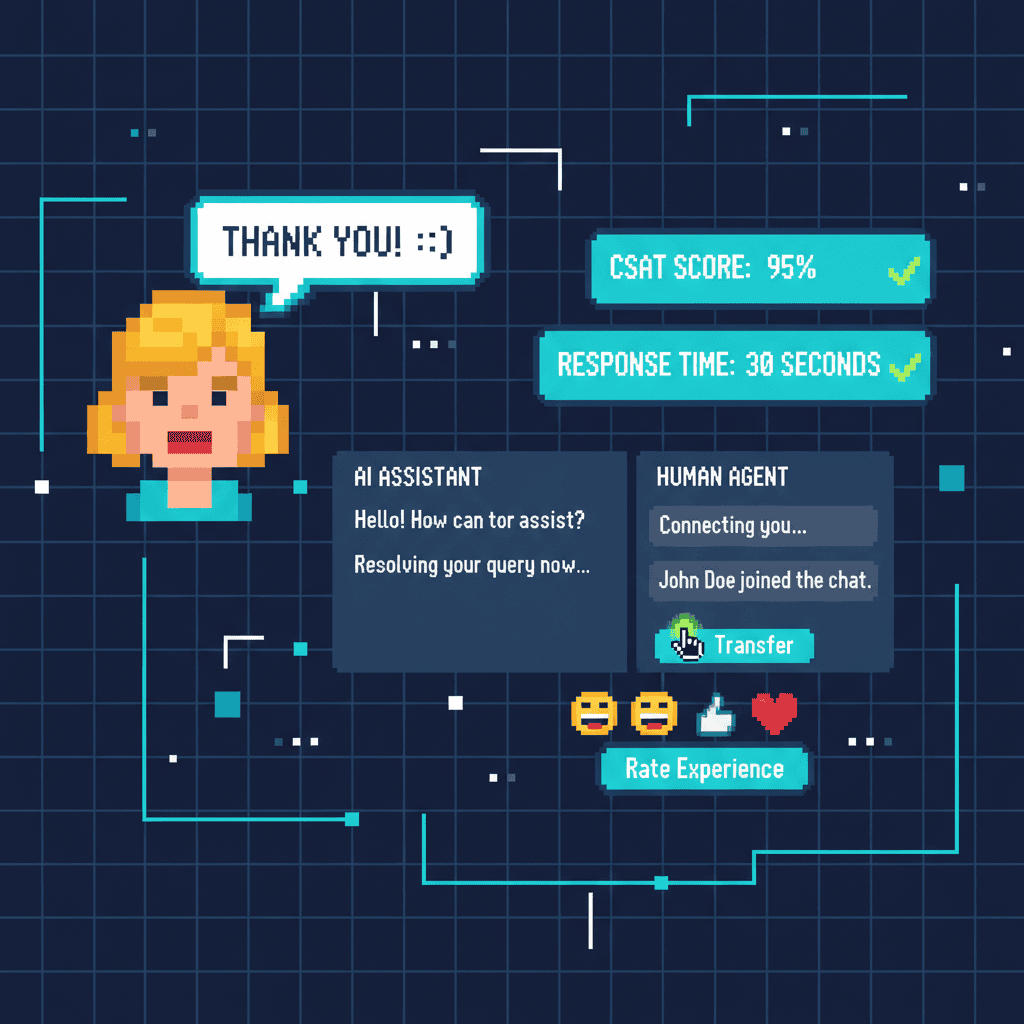
Industry benchmarks show that businesses using AI in customer service see CSAT improvements of 15-25%. To measure this, track Net Promoter Score (NPS) before and after AI implementation, compare CSAT scores on AI-assisted versus human-only interactions, and monitor first response time metrics.
One important detail: customer satisfaction measurement must account for AI plus human hybrid interactions, not just AI-only exchanges. The best results come when AI handles the routine questions and routes complex issues to your team with full context. That handoff experience is where satisfaction either thrives or drops.
For small businesses, a few extra satisfied customers can generate significant word-of-mouth referrals. One customer who had a great experience tells three friends. Those friends visit. Some become customers. The compound effect of satisfaction dwarfs the cost savings from automation alone.
Employee Burnout: The Hidden Cost AI Can Reduce
AI employee burnout reduction addresses one of the most expensive and least visible problems in small business operations. Burnout doesn’t just make people unhappy. It costs real money.
Gallup research estimates employee burnout costs $322 billion globally in turnover and lost productivity. For small businesses, the impact is disproportionately severe. In a 10-person team, one burned-out employee represents 10% of your productive capacity. Losing that person to turnover costs months of recruiting, onboarding, and lost institutional knowledge.
AI reduces burnout through three specific mechanisms:
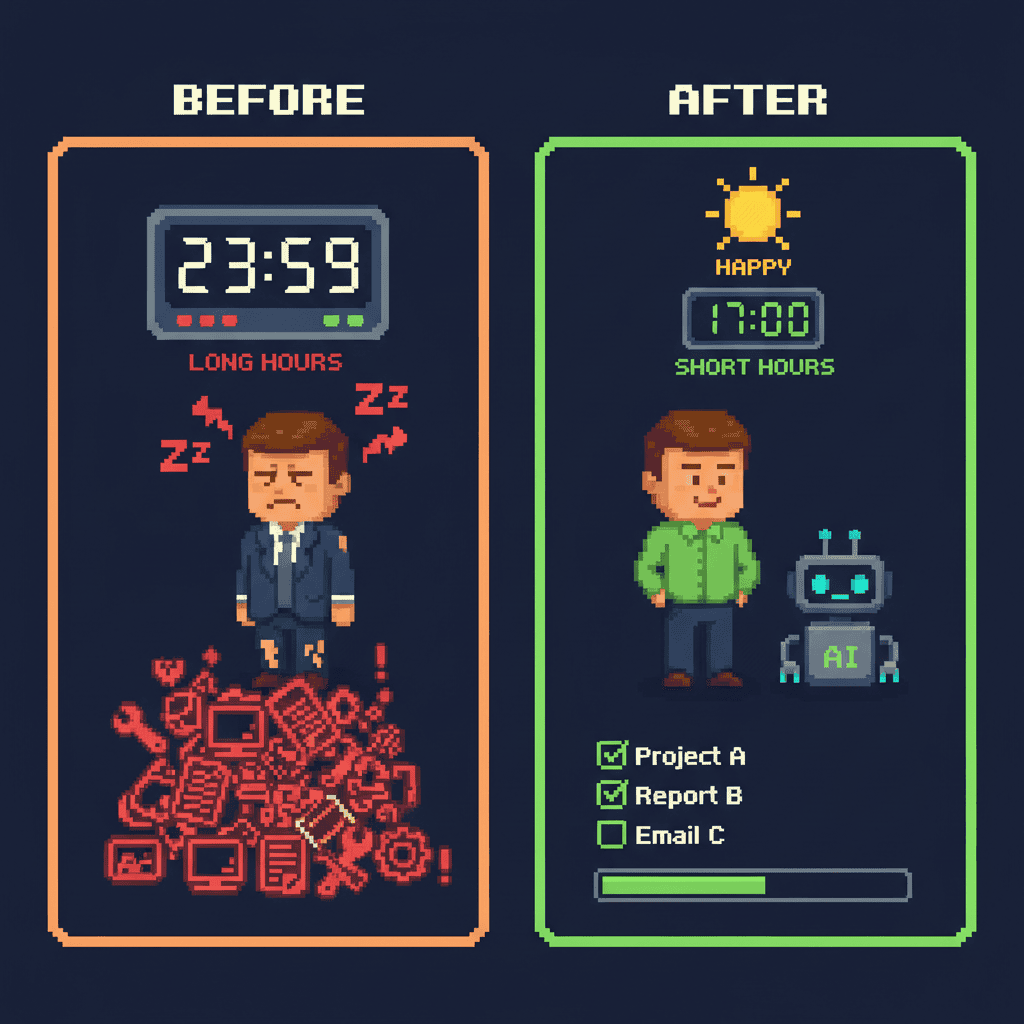
- Automates repetitive, low-value tasks: Data entry, scheduling, basic reporting, and form processing are exactly the kind of work that drains energy without requiring creativity
- Reduces after-hours work: AI handles what used to require overtime, allowing employees to actually disconnect at the end of the day
- Enables meaningful work: When AI absorbs the tedious tasks, employees redirect their energy toward creative, strategic, and high-impact work that drives satisfaction
To measure burnout reduction, track employee satisfaction surveys before and after AI implementation, monitor overtime hours reduction, watch turnover rates over 6-12 months, and gather self-reported workload assessments quarterly. Recent survey data indicates that roughly 7 in 10 employees report AI has improved their work-life balance.
Worth noting: AI reduces burnout only when implemented thoughtfully. Poorly deployed AI, such as constant monitoring tools or excessive automation that removes all human agency, can actually increase stress. The goal is to offload the work people don’t want to do, not to replace their judgment.
Learn more about how AI reduces burnout by offloading repetitive work and explore the hours AI saves employees each week.
Innovation Velocity: Measuring the Speed of New Ideas
AI innovation velocity metrics capture something that cost savings never will: the speed at which new ideas move from concept to execution. Innovation velocity determines your long-term competitiveness, and AI dramatically accelerates it.
AI accelerates innovation through four key channels:
Faster Ideation
AI brainstorming tools and rapid market research that used to take days now happen in minutes. You can generate 20 product name candidates, competitive analyses, or content angles before your morning coffee gets cold.
Rapid Prototyping
AI generates mockups, content drafts, code snippets, and design variations instantly. A small team can now produce and test multiple prototypes in the time it used to take to build one.
Data-Driven Decision Making
AI surfaces insights that humans miss. Pattern recognition across customer behavior, market trends, and operational data helps you make smarter bets on which innovations to pursue.
Reduced Iteration Cycles
Instant feedback and revision loops mean ideas improve faster. Instead of waiting days for review comments, AI provides immediate suggestions that refine concepts in real time.
To measure innovation velocity, track the number of new initiatives launched per quarter, time from idea to MVP, experiments run per month, and feature release frequency. AI-powered startups consistently launch products 2-3x faster than traditional approaches, and small businesses that adopt these tools see similar acceleration.
The frame for small businesses is powerful: AI lets small teams innovate like much larger companies. A 5-person team can now generate and test as many ideas as a 20-person team. That’s not just efficiency. That’s a competitive advantage that was previously available only to well-funded enterprises.

Measuring AI ROI Beyond Cost Savings: Comparison Table
The table below contrasts traditional ROI metrics with expanded productivity metrics. This comparison makes clear why cost-only measurement gives an incomplete picture of AI’s business impact.
| Metric Category | Traditional ROI Metrics | Expanded Productivity Metrics | Why Expanded Matters |
|---|---|---|---|
| Financial | Cost savings, headcount reduction, operational expense decrease | Revenue per employee, profit margin improvement, customer lifetime value increase | Revenue growth per employee shows true productivity, not just cost cutting |
| Time | Task completion time, project duration | Turnaround time reduction, time-to-market, response time improvement | Compressed timelines mean faster growth and more output per hour |
| Quality | Error rates, defect counts | Customer satisfaction (NPS/CSAT), quality consistency scores, repeat engagement rates | Satisfied customers are a leading indicator of sustainable growth |
| Workforce | Headcount, payroll costs | Employee engagement scores, burnout reduction, retention rates, skill development | Healthy employees produce better work and stay longer |
| Growth | Revenue increase, market share | Innovation velocity, new product cycles, experiments per quarter, ideas to execution ratio | Speed of innovation determines long-term competitiveness |
Metrics are based on industry benchmarks and Pixel Studio Creations client observations across small business implementations.
The pattern is consistent: traditional metrics tell you what you saved. Expanded metrics tell you what you gained. For small businesses where every dollar and every hour matters, the expanded view provides the intelligence you need to make better investment decisions.
Want to track your AI ROI effectively? Start with the framework in this post and reach out to us for a custom assessment tailored to your business.
How to Track These Metrics in Your Business
You don’t need expensive analytics platforms to track AI ROI measurement framework metrics. A simple, consistent approach works better than a complex one that nobody follows.
The 5-Step Measurement Framework
- Establish baseline: Measure current metrics before AI implementation. Collect 2-4 weeks of data across turnaround times, satisfaction scores, and workload indicators
- Define success criteria: What does “good” look like for each metric? Set specific targets: 30% faster turnaround, 15% higher CSAT, 20% reduction in overtime hours
- Choose 3-5 metrics: Don’t try to track everything. Pick the metrics most relevant to your specific business goals and current pain points
- Measure at regular intervals: Monthly or quarterly check-ins provide meaningful trend data. One-time snapshots don’t tell the story
- Review and adjust: Use the data to refine your AI usage, not just to validate it. If a metric isn’t improving, investigate whether it’s the tool, the implementation, or the measurement approach
Tools Small Businesses Can Use
You don’t need enterprise software to start tracking these metrics today:
- Google Sheets or Excel: Manual tracking works perfectly for most metrics. Create a simple dashboard with pre-AI and post-AI columns
- Google Analytics: Track customer behavior changes on your website
- HubSpot CRM (free tier): Monitor CSAT tracking and customer interaction quality
- Typeform or Google Forms: Run employee satisfaction surveys before and after AI implementation
- Built-in AI platform analytics: Most AI tools provide usage and performance dashboards that surface useful data automatically
The key insight is that the act of measuring itself creates accountability and focus. When you start tracking turnaround time, you naturally look for ways to improve it. When you monitor customer satisfaction, you make decisions that move the needle. Measurement isn’t just about validation. It’s about direction.
If a metric consistently shows negative trends, investigate the root cause. Is it the AI tool itself? The way your team is using it? Or the way you’re measuring it? Most measurement failures come from poor baseline data or inconsistent tracking, not from the AI underperforming.
FAQ: Measuring AI Productivity ROI
How do you measure the ROI of AI?
Measure AI ROI by tracking expanded productivity metrics beyond cost savings: turnaround time reduction, customer satisfaction scores, employee burnout rates, and innovation velocity. Start with a baseline measurement, implement AI, then measure again at regular intervals to quantify the change.
What are the best metrics for AI productivity?
The best AI productivity metrics include turnaround time improvement, customer satisfaction (NPS/CSAT), employee burnout indicators, and innovation velocity. For small businesses, focus on 3-5 metrics that align with your specific goals and measure them consistently over time.
How does AI improve employee productivity?
AI improves employee productivity by automating repetitive tasks, reducing response times, enabling 24/7 customer service, accelerating research and analysis, and freeing employees to focus on high-value creative work. The result is faster output with less effort per task.
What is AI ROI and why does it matter?
AI ROI (Return on Investment) measures the value your business gains from AI implementation compared to what it costs. It matters because AI investments require justification, and measuring comprehensive ROI helps businesses make informed decisions about where to deploy AI resources for maximum impact.
How can small businesses measure AI value?
Small businesses can measure AI value by tracking before-and-after metrics in areas like customer response times, employee workload, satisfaction scores, and output volume. Use simple tools like spreadsheets or built-in analytics dashboards rather than expensive enterprise platforms.
Conclusion: See the Full Value of Your AI Investment
The five expanded metrics we’ve covered, turnaround time, customer satisfaction, burnout reduction, innovation velocity, and revenue per employee growth, paint a complete picture of what AI delivers for small businesses. Cost savings are real, but they’re just the beginning.
AI’s true value lies in what it enables, not just what it saves. It enables faster service, happier customers, healthier teams, and more frequent innovation. Small businesses that measure the full productivity picture make smarter AI investment decisions and capture value that their competitors miss.
The framework in this post gives you everything you need to start measuring today. Establish your baselines, pick your metrics, and track them consistently. The data will guide you toward better decisions, and the results will compound over time.
See how how startups use AI to multiply their output and explore how AI improves customer satisfaction for more examples of expanded AI value in action.
Ready to Build a Complete AI Strategy That Delivers Measurable Results?
Pixel Studio Creations helps small businesses implement and measure AI tools that actually work. Contact us for a free AI ROI assessment and see where your business stands.