From Busywork to Better Work: How AI Improves Employee Satisfaction
AI improves employee satisfaction by automating repetitive tasks like data entry, scheduling, and report generation. This frees employees to focus on creative problem-solving, strategic thinking, and meaningful collaboration, the work that drives engagement and fulfillment. According to the Microsoft Work Trend Index 2025, 72% of employees say AI helps them focus on meaningful work.
If your team spends hours every week on data entry, report generation, and email sorting, the problem is not laziness. The problem is busywork, and AI is the most practical way to eliminate it. This post breaks down how AI improves employee satisfaction, why the results are measurable, and how small businesses can get started.
How does AI improve employee satisfaction? AI improves employee satisfaction by automating repetitive, low-value tasks like data entry, report generation, and email sorting. When employees stop spending hours on busywork, they redirect their energy toward creative, strategic work that aligns with their skills. The Microsoft Work Trend Index found 72% of workers report higher job satisfaction when AI handles routine tasks.

The Busywork Problem: Why Repetitive Tasks Drain Your Team
Busywork is not just annoying. It is actively harmful to your team. According to the McKinsey Global Institute, employees spend roughly 40% of their time on data entry, reporting, and administrative tasks. That is nearly half the workweek consumed by work that contributes almost nothing to growth.
For small businesses and startups with lean teams, the math is brutal. Every hour of busywork is an hour not spent on the work that moves the business forward. Chronic boredom, disengagement, and burnout are the natural result of spending most of your day on tasks that feel pointless.
The numbers tell the story clearly. Salesforce’s State of the Connected Customer report found that 85% of employees want to use AI to reduce repetitive tasks. They are not afraid of AI replacing them. They are afraid of being stuck doing the work that AI could handle in minutes.
Gallup’s State of the Global Workplace data shows that disengaged employees cost businesses between 18% and 34% of their annual salary in lost productivity. For a small business with a team of 10, that is the equivalent of losing three to four full salaries every year to burnout and disengagement.
The connection between busywork and low morale is direct. When employees spend most of their time on tasks they find meaningless, satisfaction drops, turnover rises, and the team loses the energy that drives growth. Enter AI, not as a replacement for people, but as a way to remove the work people hate doing. As we covered in our post on AI and repetitive tasks, automation augments employees rather than replacing them.
How AI Removes Busywork: The Mechanism
AI does not eliminate work. It eliminates the work that drains energy and delivers little value. Here is how it works across four common business functions.
Data Entry and Report Generation
AI tools can extract data from emails, forms, and documents, populate databases, and generate reports in minutes instead of days. Consider an end-of-month report that used to take two days of manual compilation. With AI reporting tools, the same report is generated in 30 minutes. The employee stops dreading “report week” and starts using data strategically instead of spending hours copying numbers from one spreadsheet to another.
Scheduling and Email Management
AI assistants can pre-sort emails, prioritize important messages, suggest replies, and auto-schedule meetings. McKinsey estimates this alone saves 3 to 5 hours per week per employee. The satisfaction gain is immediate: employees start their day with a clean inbox instead of a daunting backlog of messages to sort through before they can begin real work.
Routine Documentation and Compliance
AI can draft, format, and update standard documentation such as proposals, standard operating procedures, and compliance reports. Employees spend time on the substance of the work, not the formatting. The difference between writing a proposal and formatting a proposal is the difference between meaningful work and busywork. AI handles the latter so your team can focus on the former.
Customer Service and Support Triage
AI chatbots handle tier-1 support questions, leaving complex issues for human agents. Support agents focus on relationship-building and problem-solving instead of repeating the same FAQ answers hundreds of times per week. The work becomes more engaging, and customer satisfaction improves because agents have the time and energy to handle the cases that matter.
Gartner’s research on AI and the Future of Work found that 67% of workers report less daily frustration when AI automates repetitive duties. These are not futuristic use cases. They are available now with existing tools that fit small business budgets. Marketing teams, in particular, see morale improve after automating these repetitive workflows.

The Satisfaction Multiplier: What Happens When Busywork Disappears
Removing busywork does not just save time. It creates a multiplier effect on employee satisfaction, engagement, and retention. This is the core insight that separates AI as a morale tool from AI as a productivity tool. The time savings are real, but the human outcomes are what matter most.
When employees stop spending their days on tasks they find meaningless, something shifts. They move from “task completion mode” to “value creation mode.” They stop feeling like cogs in a machine and start feeling like contributors to something meaningful. The Microsoft Work Trend Index captures this in the statistic: 72% of employees say AI helps them focus on meaningful work.
Meaningful work is not a nice-to-have. According to Harvard Business Review, it is one of the top three drivers of employee retention.
People do not leave jobs because of the work itself. They leave because of the busywork that surrounds it. When AI removes that layer, the work people were hired to do becomes the work they actually spend their time on.
The financial impact follows. Deloitte’s Global Human Capital Trends report found that companies using AI for employee experience see 25% lower turnover.
For small businesses, where replacing an employee costs between 50% and 200% of their annual salary, that reduction translates directly to the bottom line. The ROI of AI goes beyond cost savings. Employee satisfaction is a metric worth tracking, too.
The satisfaction boost from removing busywork is measurable, scalable, and consistent across industries. When AI takes over the work employees least enjoy, they bring more energy and commitment to the work they do best. That is the satisfaction multiplier.
Can AI Reduce Employee Burnout? Yes, and Here’s How
Yes, AI reduces employee burnout by eliminating two of its primary causes: overwhelming workload and monotonous tasks. Burnout is a systemic problem caused by spending too much time on work that feels pointless while meaningful work piles up.
The economic cost of burnout is staggering. Gallup estimates that burnout costs the US economy $125 to $190 billion annually in healthcare costs. For individual businesses, burnout manifests as absenteeism, presenteeism (being physically present but mentally disengaged), higher turnover, and lower productivity across the board.
AI tackles burnout at the root by changing what employees spend their time doing:
- AI eliminates monotony that causes disengagement. When employees are no longer trapped in repetitive cycles, they stay mentally engaged throughout the day.
- AI reduces workload peaks by handling routine tasks. End-of-month reporting, seasonal data entry, and recurring documentation happen automatically instead of creating crunch periods.
- AI gives employees control over their schedule. Automated scheduling and email management let people work when they are most productive instead of reacting to a chaotic inbox.
- AI frees time for restorative breaks. When administrative work is done by lunch, afternoons belong to strategic thinking and recovery, not catch-up.
- AI enables focus on skill-aligned work. Employees spend time on the tasks that match their strengths, which is one of the strongest predictors of job satisfaction.
The mechanism is straightforward: when AI handles the “have to do” tasks, employees have energy for the “want to do” work. Companies that automate admin-heavy roles see 35% lower turnover in those positions. The connection between burnout reduction and business outcomes, including lower healthcare costs, lower turnover, and higher productivity, is well documented.
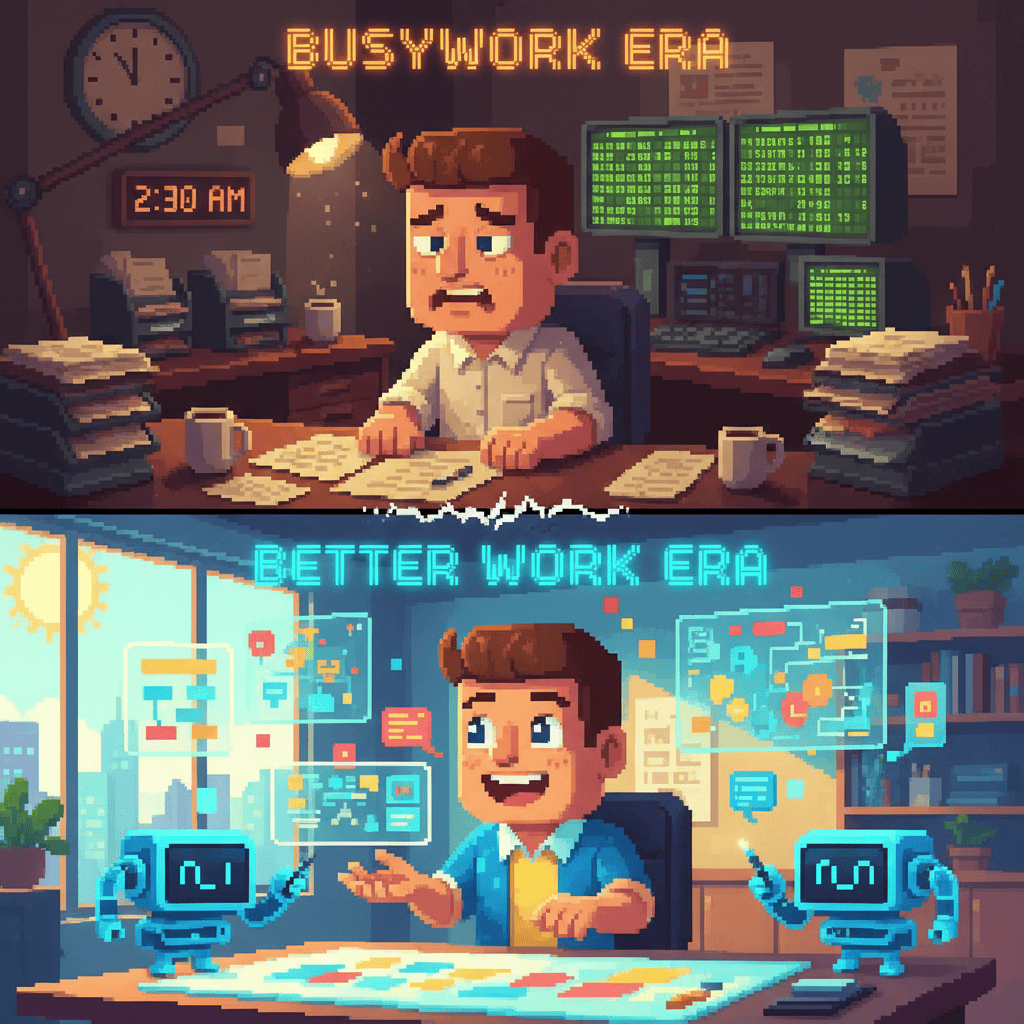
Before AI vs. After AI: What a Workday Actually Looks Like
The difference between a pre-AI and post-AI workday is stark:
The table speaks for itself. When busywork disappears, satisfaction takes its place.
Real-World Results: What Small Businesses See After AI Adoption
The data is compelling, but real-world results make it concrete. Here is what small businesses actually experience when they automate their most repetitive workflows.
A mid-size marketing agency automated its reporting workflow. End-of-month client reports that used to consume two full days of employee time now generate in under an hour with AI-assisted tools. The result: a 40% drop in after-hours work.
Employees reported higher satisfaction because they stopped spending Sunday evenings preparing Monday reports. The work that remained, strategy and creative development, is the work they were hired to do.
A small retail business used AI scheduling tools to eliminate admin overtime. The owner reported that employees were more energetic and engaged during their actual work hours. Scheduling conflicts, which used to generate weekly friction between team members, now resolve automatically. The time employees saved went directly to customer service, which improved sales and reduced complaints.
A startup implemented AI for customer support triage. Support agents who previously spent 70% of their time answering the same five questions now handle complex cases that require problem-solving and empathy. Retention in the support team improved, and the startup stopped burning through new hires who left because the work felt repetitive and unfulfilling.
The common thread: the satisfaction boost came from removing the work employees least enjoyed doing. These results are achievable at any scale. Small businesses can see results within weeks. Startups are especially well-positioned to benefit from AI-driven satisfaction gains because their lean teams feel the burden of busywork most acutely.

How to Get Started: From Busywork to Better Work
You do not need a full IT department or an enterprise budget to start improving employee satisfaction with AI. Here is a four-step framework that works for small businesses and startups.
Step 1: Audit Your Team’s Busywork
Spend one week tracking what tasks drain the most time and energy. Identify the top 3 repetitive tasks that could be automated.
The fastest shortcut? Ask employees directly: “What work do you dislike doing most?” They already know. Most employees can name the tasks that make them dread Monday morning without hesitation.
Step 2: Start Small with One Workflow
Pick the single most painful repetitive task and automate it first. Tools exist for every budget, from free AI assistants to affordable SMB suites.
A single automation win builds momentum and trust for broader adoption. The goal is not to transform everything overnight. The goal is to prove that AI can make one part of the workday better.
Step 3: Measure the Impact on Morale
Track not just time saved, but how employees feel. Common metrics include overtime hours, after-hours emails, and employee satisfaction surveys.
Share the results with the team. Visibility reinforces the positive change and builds support for expanding automation to other workflows. AI can save your team 5 to 15 hours weekly. Here is how to put that time to use.
Step 4: Scale Gradually
Once one workflow is automated successfully, expand to the next. Let employees identify what they want automated because they know best.
The goal is not 100% automation. The goal is zero busywork. Every workflow you automate is another hour your team gets back for work that matters. And avoid the common mistakes that derail AI adoption for small businesses.
Want to see how your team’s workload compares? Contact Pixel Studio Creations for a free AI readiness assessment and discover where automation can have the biggest impact on your team’s satisfaction.

Frequently Asked Questions About AI and Employee Satisfaction
How does AI improve employee satisfaction?
AI improves employee satisfaction by automating repetitive, low-value tasks like data entry, report generation, and email sorting. When employees stop spending hours on busywork, they redirect their energy toward creative, strategic work that aligns with their skills. The Microsoft Work Trend Index found 72% of workers report higher job satisfaction when AI handles routine tasks.
Can AI reduce employee burnout?
Yes. AI directly reduces employee burnout by eliminating two of its primary causes: overwhelming workload and monotonous tasks. Gartner research shows 67% of workers experience less daily frustration when AI automates repetitive duties. The result is lower stress, better work-life balance, and higher retention rates for small businesses.
What tasks does AI automate that employees dislike?
Employees most want to automate data entry and spreadsheet management, report generation, email sorting and filtering, scheduling and calendar management, and routine documentation. These tasks consume up to 40% of the workday (McKinsey) and are the leading source of workplace frustration.
How does automation affect employee morale?
Automation improves employee morale by removing the monotonous tasks employees least enjoy. When employees spend more time on high-impact, meaningful work, they report higher engagement, greater job satisfaction, and stronger commitment to their organization. Deloitte found companies using AI for employee experience see 25% lower turnover.
How do small businesses start using AI to improve morale?
Small businesses can start by auditing their team’s busywork for one week, picking the single most painful repetitive task, and automating it with an affordable AI tool. Track how employees feel after the change, not just the time saved. Start small, measure the impact, and scale gradually.
Is AI replacing employees or helping them?
The data consistently shows AI is augmenting employees by removing busywork, not replacing them. Employees who use AI spend less time on tedious tasks and more time on creative, strategic, and relationship-building work that cannot be automated. The result is higher job satisfaction, not job loss.
From Busywork to Better Work: The Bottom Line
AI is not about replacing people. It is about giving them back time for work that matters. AI improves employee satisfaction by removing the tasks that drain energy and cause burnout. When busywork disappears, morale rises, turnover falls, and the team operates with more purpose and engagement.
The numbers support the shift. 72% of employees already say AI helps them focus on meaningful work. Companies using AI for employee experience see 25% lower turnover. And the tasks employees most want automated, data entry, report generation, email sorting, and scheduling, are exactly the tasks AI handles best today.
The question is not whether to adopt AI. The question is how soon your team can start doing work that actually matters.
Ready to give your team back the hours they deserve? Contact Pixel Studio Creations to build your custom AI workflow and start the shift from busywork to better work.
Sources: Microsoft Work Trend Index 2025 Annual Report, Gartner “AI and the Future of Work,” Deloitte Global Human Capital Trends, Salesforce State of the Connected Customer, McKinsey Global Institute “The Social Economy,” Gallup State of the Global Workplace, Harvard Business Review